Saturday, July 1, 2023

A Tragedy Waiting To Happen

A true story that peaks with violent death focuses, of necessity, on events that seem most relevant to the main theme. This often lends an aura of inevitability to those incidents. For career criminals, it seems like each transgression spirals the individual further into “the dark side.” Phillip Basselli was a criminal only in that he kept getting into personal trouble; he made his living as a coal miner. Yet the end of his short life displayed a slide into tragedy that seemingly nothing could stop.

Phillip was born June 2, 1915 in Pierce County, Washington, into a solid immigrant family. His parents were Frank and Concetta Basselli, both natives of Italy. Frank (Francesco) came to this country around 1906, when he was about 19 years old. He found work in the coal mines located 20-30 miles southeast of  Tacoma. At that time, demand for coal had fueled a minor boom in the area. Concetta Yozzolino (records show several variations of her name) arrived in February of 1911, when she was about 15 years old. Perhaps by pre-arrangement, she and Frank were soon married. They had a son, Anthony, in August 1912. Daughter Mary came two years later, then Phillip.

With a growing family, Frank moved into a house in Carbonado, located in the middle of the coal region. This was a typical “company town,” in the sense that the coal company owned most of it. Still, state law prohibited the worst “wage slave” practices and the employer did provide schools, a hospital, and (slowly) upgraded housing. Of course, the company much preferred a work force of “contented” family men since they were considered less likely to go on strike.

Phillip’s father was an exceptional man. By the time he registered for the draft in 1918, he had advanced to a position as motorman. That is, he operated a small train that carried supplies into the mines and hauled coal out. His typical earnings were better than those of an ordinary miner, plus the job was safer (relatively speaking) and less physically demanding. Some time in the Twenties, Frank actually purchased the family home, a step that was almost unheard of in such company towns. 
Motorman and Train.
Pacific Coast Bulletin (October 28, 1927).

Phillip reached his teen years with no foretaste of later trouble. In fact, he seems to have done well in school. Thus, in 1932, the family enrolled him at Bellarmine, a Roman Catholic prep school in Tacoma. He perhaps stayed some of the time there with his sister Mary, who had married a Tacoma barber the year before. (Brother Tony also married in January of 1932.) Phillip proved to be a talented athlete: he was a starter at halfback in football and a solid scorer on the basketball team.

Unfortunately, he was no longer on the roster for either team the following year. We don’t know if he dropped out on his own, or if the family could no longer afford to send him there. Either way, Phillip joined throngs of low-skilled workers scrambling for jobs during some of the worst years of the Great Depression. Perhaps because of that, he began to exhibit a surly, belligerent disposition. He also drank to excess, which only fueled his angry, aggressive behavior. One incident occurred at a lunch counter located about nine miles north of Carbonado. The young man entered late one night and demanded a beer, although he was already a bit tipsy. Because it was after hours, the operator refused, so Phillip punched the man in the mouth and knocked him out.

The summer of 1935 brought another foretaste of events to come. He barged into “Don’s Tavern” in Wilkeson, a hamlet a couple miles north of Carbonado. Then he got into a heated argument with Don Pettit, the owner. By this time, people knew that Basselli’s hot temper could get out of hand. Thus, Pettit retrieved a pistol from behind the counter and ordered him to get out. Only when Pettit threatened to actually shoot did the angry young man leave.

Donald Lyman Pettit was the other actor in this tragedy. Don was born near Walla Walla, Washington on February 10, 1895. For a time between about 1915 and 1918 he covered the west as a traveling salesman. Then he settled in Seattle, where, in January 1919, he married for the first time. That didn’t last long, with Pettit being granted a divorce in the summer of 1921. Some time after that, he made Spokane a base for selling mining company stock. In April 1922, he married again – in Coeur d’Alene, Idaho.

In 1923, he and his new wife returned to Seattle, where Don worked as a salesman for a golf equipment company. The following year, the couple had a daughter, Katherine. He was still working as a salesman in 1933, but he and his wife had separated by then. A year or so later, Pettit opened the tavern in Wilkeson. (National Prohibition had been repealed at the end of 1933.) The clash there in the summer of 1935 sowed the seeds for what was to come.

Before that happened, Phillip added to his disrepute. He landed a job in Mullan, Idaho, a major silver mining site. However, in September, Basselli tried to beat up a company cook and ended up in jail on a drunk and disorderly charge. It’s unknown how much time he served, if any. In any case, Phillip was back in the Carbonado area by the following March. He tangled with Pettit again at a lodge meeting in Wilkeson, after gleefully noting that the tavern owner carried neither a gun nor a sap: “I’ve got you man to man.”  

Historic Carbonado. City of Carbonado.

Pettit, over 40 years old, stood no chance against the young, athletic miner. He suffered two or three broken, or at least cracked ribs and a kick to the groin. Fights were hardly rare in this working-class environment, so Basselli was not charged with assault. Perhaps it would have been better if he had.

About the same time, Basselli blew up in the bar and grill across the street from Pettit’s tavern. He then smashed some windows by throwing beer bottles at them. He paid $27 in damages for that incident. In May, Phillip was fined $10 on another drunk and disorderly charge. His sentence included six months in jail, but that was suspended when Phillip promised that he would “refrain from getting intoxicated.” Again, matters might have been better if he had actually served that term.

Given Phillip’s recent past, it’s unlikely that his promise lasted very long. Events came to a head on the evening of Saturday June 13, 1936. When the drinking began is unclear, but it went on until closing time (1:00 o’clock) on Sunday morning at the Wilkeson bar and grill. Basselli was “in a quarrelsome mood,” and still resentful about the $27 his previous tantrum had cost him. He muttered about whacking the owner with a poker and threatened to punch out a waitress. Unable to obtain more booze, a half dozen customers, including Phillip, decided to try their luck across the street at Don’s Tavern.

Basselli and one companion entered the bar, where Don had just served a last call to two final customers and was in the process of closing up. Phillip demanded a beer, which Pettit naturally refused. The young man plopped into a booth for a moment, then rose to argue with Don. Then there was a distraction. Two members of the group outside got into a fistfight. (All would later claim, under oath, that no one was drunk … but the evidence is against them).

Still, despite the confusion, witnesses inside agreed that Basselli aggressively accosted the bar man and threatened him. Pettit thought the youth was going to jump the bar, and was in no mood to get beat up again by the young, muscular miner. He grabbed his pistol and fired two warning shots into the ceiling. Observers now had their attention divided by the fight outside. Thus, none could say exactly what happened next. They all remembered that three shots were fired, but could not verify (or deny either) Pettit’s claim that he aimed the third shot at the advancing miner’s shoulder. But Phillip apparently realized that Pettit really was going to shoot and twisted aside at the last second. That, however, only made matters worse. Instead of hitting the shoulder straight on, the third bullet entered the back side at an angle that traversed the lungs and tore the top of his heart. Basselli staggered away a bit, then slumped to the floor and died.

Charged with murder, Pettit claimed self-defense, and seemed to have a good case. During the subsequent trial, the defense featured a parade of witnesses who attested to Phillip’s belligerence and propensity for physical violence (outlined above). The prosecution made no attempt to counter with witnesses who might have spoken of Basselli’s better qualities. They based their case on the assertion that Pettit had been waiting for his chance at revenge, and this was it.

Criminologist Luke S. May verified the death weapon, of course, and probably gave an assessment of the bullet trajectory. Investigators did not, or could not, retrieve the two bullets fired into the ceiling. May also noted that the death pistol, a .32-caliber automatic, would not show powder burns beyond about 15 inches. No such burns were observed, but the defense then asserted that officials had tampered with the evidence. That was unlikely, and the claim was necessary only if the defense wanted to prove that Phillip was almost on top of the shooter when he was hit. However, as suggested above, even if Basselli had been at or near the bar, his turn at the last moment would have probably moved him out of close range.

Given the overwhelming testimony about Phillip’s violent nature, Pettit’s self-defense plea might have worked. Three factors counted against him, starting with the victim’s youth and the fact that he was a “local boy.” Also, Pettit showed no particular remorse, conveying the notion that the young ruffian had brought it upon himself.

Worse yet, he backed that attitude with action. The exact sequence of events is unclear, but it included Pettit dragging Basselli’s body outside onto the sidewalk. He also mopped up any blood – there were almost surely some stains – and finished his closing procedures. He had Phillip’s companions inform the sheriff in Carbonado, and told a local undertaker about the body. Then he went home to bed.

His attitude and actions evidently did not play well with the jury of five man and seven women. They convicted Pettit of first degree murder. At least they did not recommend a death penalty. The judge then imposed a “mandatory” life sentence.

Sadly, death visited the Basselli family again in early 1940, when Frank died at the relatively young age of 53. Within a year, Concetta moved into Tacoma to be near married daughter Mary and two grandsons. She was blessed with a third grandson around 1945. She passed away there in 1986.

Around 1937, not long after Don Pettit went off to prison, his wife moved to Portland, Oregon, There, she found work as a department store saleslady. Their daughter Katherine went to live with relatives in Spokane, where she attended high school. After graduation, she also moved to Portland. Don’s sentence was commuted in early 1943 and he was soon a free man. He too ended up in Portland, although it’s unclear exactly when.

In the spring of 1946, daughter Katherine married in Portland. Several years later, the couple moved to California. Pettit’s wife obtained a divorce in August 1947 and remarried a bit over a year later. Donald also married again. In 1950, he and his third wife were operating a trailer court in Portland. He died there two years later from an aggressive brain tumor.
                                                                                
References:  “[Basselli-Pettit News],” Seattle Times, Bellingham Herald, Daily Ledger, Tacoma, News-Tribune, Tacoma, Spokesman-Review, Spokane, Union-Record, Seattle, Washington; The Oregonian, Portland, Oregon (June 1921 – August 1952).
Edward Echtle, “Carbonado — Thumbnail History,” Online Encyclopedia of Washington State History, HistoryLink.org, Seattle, Washington  (January 24, 2018).
Luke S. May, Luke S. May Papers, Special Collections, University of Washington, Seattle, Washington (1969).

Tuesday, May 9, 2023

A Jury Of His Peers

By the end of 1930, pioneer criminologist Luke S. May had logged over 140 death cases. For the decade, he had averaged about one death case every month. Of course, the Pacific Northwest suffered far more mysterious deaths than that. However, we must keep in mind that Luke was a private investigator. He was hired only when regular law enforcement couldn’t handle the job, for whatever reason. The cases were not “routine” because of the stakes involved – eight out of ten included murder charges. Anyway, over one hundred of those events involved guns. By this time, Luke had honed his firearms techniques to where they needed little further adjustment. However, a death case he logged in early 1931 proved a bit different, because of two unusual circumstances.

The death took place in the small hours of November 12, 1930, during the night after Armistice Day. May logged the case and received key evidence in January 1931. The victim was LeRoy “Roy” Blank, who was born around 1903 in rural Minnesota. In 1916-1917, the family moved to a farm in central North Dakota. Sadly, Roy became the “man of the family,” when his father died in the summer of 1918. Unable to hang on, they were all back in Minnesota in 1925. During the next two or three years, Roy went off on his own while his mother and four siblings made their way to Minneapolis.

Accounts do not say how Roy ended up as a farm laborer near Connell, Washington, a small town located about thirty miles north of Pasco. Nor do we know how long he had been seeing Helen (Beck) Fishan, a live-in housekeeper and nanny in Kahlotus, an even smaller hamlet about fifteen miles east of Connell. 
Connell, Washington, ca 1928. Washington Rural Heritage.


Helen M. Beck was born August 10, 1900 in a farming area of Missouri about 45 miles northwest of St. Louis. Around 1909, the family moved to the Idaho Panhandle, being in Post Falls in 1910. By 1918, Helen was teaching school in and around Spokane, Washington. In February of 1922, she married Howard J. “Jack” Fishan in Spokane. They had a daughter in November. However, for unknown reasons, the couple separated around 1926. Not long after that, Helen took the job in Kahlotus.

Her employer was Samuel J. “Sam” Watson, a long-time resident of Kahlotus. Watson was born around 1885 in New York City. Before 1900, the family moved to eastern New Jersey. It’s uncertain when Sam went out on his own, but in 1909-1910, he settled in Kahlotus. There, he operated the steam engine for a processing plant, probably a flour mill. In January 1912, he married Bertha Cook, a local girl who clerked at the general store. They had a son after about a year. Before 1918, Sam also began delivering milk around the area, perhaps from a small herd of his own. At some point, he also opened a pool hall in the town.

Sam and Bertha added two daughters to the family, in 1916 and 1922. Sadly, Bertha passed away in the fall of 1924. Although we don’t know for sure, Sam may have had other housekeepers before he hired Helen Fishan in 1926-1927. Early on, Sam thought they had an “arrangement” that he considered an engagement. However, at some point he discovered that Fishan had not yet obtained a divorce from her husband. Even so, Sam and Helen soon began “living together as husband and wife,” raising his three kids as well as Helen’s daughter Maxine.

Although she was willing to sleep with Sam, Helen never saw the situation as an engagement. Thus, she was receptive when Roy Blank began paying attention to her. After all, Blank was close to her age, whereas Sam was practically old enough to be her father (17 years her senior). Naturally, Sam objected, and insisted that she stay away from Roy.

Matters reached a crisis point on Armistice Day. Although it was not yet a federal holiday, towns large and small celebrated the Day with parades, speeches, and other activities. Later testimony confirmed that all three principals in this love triangle had been drinking off and on, all day and late into the evening. (Prohibition was still in force, but hardly anyone paid any attention to that.) Were they together, paired off some way, or what? We don’t know.

Some time after midnight, Sam began driving around looking for Fishan. He found her with Blank in his car on the outskirts of Kahlotus. The subsequent shouting match caught the attention of neighbors, who then heard three quick gunshots. Witnesses who rushed over found two victims on the ground near Blank’s car. Blank was already dead, while Fishan was badly wounded. Watson had left the scene; he was on his way to Pasco to turn himself in. He would later claim that he didn’t know he’d hit the woman until the sheriff told him.

Helen Fishan was rushed to another nearby small town, where the attending physician decided she needed specialist help and transferred her to a hospital in Spokane. The surgeon who operated said he was doubtful she would survive. The bullet had passed through her abdomen, piercing her bladder and bowels. Amazingly, she was considered out of danger about ten days later. At that point, the county attorney lodged a felony assault charge against Sam, to go with the murder charge for the death of Roy Blank. By this time, Blank’s body had been transported to Minneapolis for burial.

Sam Watson asserted that Roy had advanced in a threatening manner, with something in his hand. He therefore claimed self-defense. Oddly enough, he had suffered a wound himself … a finger on his left hand had been badly injured and eventually had to be amputated. His defense attorney would later imply that other shots had been fired and one of those had hit Watson. However, listeners heard no other shots and examination of the death scene found no weapons of any kind, not even something that might be mistaken for a club.

Luke May received evidence for the case just under two weeks before Watson’s trial was to begin in February. That included the death weapon (a Colt double-action revolver chambered for 44 WCF ammunition), three 38 WCF shell casings, and two unfired 38 WCF cartridges. Luke soon confirmed that the powder explosion had expanded the brass shells to closely fit the larger chamber. It’s worth noting that the difference between the 38 and 44 WCF ammunition is not as great as the stated numbers suggest. Those are for “marketing” purposes (more or less). The actual bullet diameter is less than 0.03 inch different, and some other dimensions are even closer. Luke also found that the revolver was old and poorly maintained, with noticeable rust and erosion in the barrel. These factors complicated the death bullet comparison, but not seriously. 
Colt double-action revolver, 44-40. Antique guns site.


Luke strongly urged county authorities to search for the bullet that had wounded Fishan, which “should be found in the immediate vicinity of where she was shot.” Since the slug had passed through soft tissue, a comparison should easily verify that it came from Watson’s weapon. Luke doesn’t mention another point: He could have assessed the bullet trajectory to further affirm that Watson had fired the wounding shot. Officials did not, however, heed his recommendation.

Luke also received Watson’s amputated finger, preserved in alcohol. The prosecutor assumed that Sam had shot himself and wondered what powder burns might appear. (The two doctors who treated Watson’s finger disagreed on whether or not they saw visible powder burns.) Thus, May spent considerable effort to test the weapon and ammunition for that feature.

Several key points stood out. The revolver’s mechanism was rather loose, allowing gas and unburned powder to blow back. Luke also noted that the cartridges were “loaded with the fastest burning powder that there is on the market.” Coupled with the long barrel of the revolver, relatively little unburned powder would be expelled. Finally, the slightly smaller bullet size allowed some gas to escape and reduced the pressure to throw unburned grains very far. May’s testimony therefore noted that a major powder burn could not be expected, even at fairly close range. Nonetheless, his careful microscopic scrutiny detected several particles of unburned powder embedded in the damaged finger.

Watson’s defense never disputed that there had been a shouting match. Nor did they deny that he had tried to break up the relationship between his “housekeeper” and Blank. Sam had simply felt threatened by the younger man and sprayed him and Mrs. Fishan with bullets. And, in the end, that defense was enough. The jury – eleven men and one woman – took just one ballot to acquit him on both counts. There was no indication that they even considered some lesser charge for his “accidental” near-death wounding of Helen Fishan.

Helen and her husband reconciled after the trial, although it’s unclear exactly when. They had two more daughters, one in the spring of 1934 and another in 1935. They settled near Spokane as a base. Helen found work – probably as a domestic servant or part-time teacher – in and around that city. However, in the depths of the Great Depression, Jack had to make do with short-lived jobs around the region, including in Idaho. Sam Watson’s younger daughter was about the same age as Maxine Fishan. Thus, after Jack and Helen settled around Spokane, she chose to live in that area too.

Records kept by the U.S. Veterans Bureau (now Administration) show that Howard Jack Fishan died March 12, 1945 in Spokane. During World War I, he served in France with a machine gun company of the 361st Infantry Regiment, originally formed at Camp Lewis, Washington. Helen (Beck) Fishan passed away May 10, 1976 in Spokane. The obituary listed as survivors her two brothers and three married daughters as well as the younger Watson daughter (married, and living in Spokane at that time). Helen also had eleven grandchildren and seven great-grandchildren.

Sam Watson stayed in Kahlotus at least until 1940, when he and his older daughter, Lucille, were enumerated in the census. As noted above, the younger daughter lived near Spokane at that time. Sam’s son scrambled to find work in the region around Kahlotus, until he joined the Army in 1941-1942. He married in 1943 and lived in Seattle after the war.

Lucille married about the time her brother entered the Army. However, she gave her status as “Widow” in the 1950 Census for Compton, California. At that time, Samuel J. Watson was living with her and her twin sons. Sam moved back to Seattle, Washington at some point, perhaps when his grandson (Lucille’s son) married in 1963. He passed away there in September 1964.
                                                                                
References:  Linda Holden Givens, “Connell – Thumbnail History,” Online Encyclopedia of Washington State History, HistoryLink.org, Seattle, Washington  (June 24, 2021).
Luke S. May, Luke S. May Papers, Special Collections, University of Washington, Seattle, Washington (1969).
“[Participant Backgrounds],” Spokane Chronicle, Washington, Bellingham Herald, Washington, Spokesman-Review, Spokane, Washington; Minneapolis Star, Minnesota (January 1918 – May 1976).
“[Killing and Trial],” Bellingham Herald, Washington, Spokane Press, Washington, Spokesman-Review, Spokane, Washington; The Oregonian, Portland, Oregon (November 1930 – February 1931). .


Thursday, March 2, 2023

The Farmhand Murder Mystery

February 1933. Daniel L. Blankenship had a problem. As sheriff of Kitsap County, Washington, he received tips regularly – from known sources, or anonymous. Many were baseless, but all had to be investigated. And, like many sheriffs of that era, he had virtually no training in law enforcement. He had to rely on common sense and local knowledge.

Daniel was born in West Virginia in the spring of 1887. In 1906, the family moved to Williston, North Dakota, a small town in the northwest part of the state. In September of the following year, Daniel married Marilla Young there. Later, the couple moved to a tiny town in northeastern Montana about forty miles from the Canadian border. At that time, he dealt in real estate. However, some time in 1921-1925, they separated, with Marilla awarded custody of their three children. Soon after that, Daniel moved to near Bremerton, Washington. In December 1925 he married again. Then, before 1929, he opened a car dealership in Bremerton. 
Downtown Bremerton, bef 1929.
Kitsap History Museum.


In January of 1931, Daniel was sworn in as sheriff of Kitsap County. Aside from Bremerton, with its U.S. Navy shipyard, the county was quite rural. Thus, Blankenship’s duties were comparatively light: Serving legal notices, an occasional missing persons report, escorting prisoners to and from various locations, and so on.

This anonymous tip was far more serious. It claimed that one John E. Martin had shot and killed two itinerant workers, known only as “Milo” and “Pete,” and buried them on his farm. Martin was a newcomer to the area, having recently acquired land on the coast of Puget Sound about twenty miles north of Bremerton. He had twice come to the attention of authorities. The regional Prohibition Officer had searched his property for a rumored moonshine operation, but had found nothing. (Prohibition was on its way out, but the laws were still being enforced.)

More relevant was a report from the previous October. Neighbors had found Martin almost incapacitated from severe cuts and bruises, and rushed him to medical help. He said that two temporary farm hands had beat him up and tried to rob him. They had been there about a week, clearing brush, when he fired them for drinking too much. Martin had no money to speak of on the property, and he said the two fled after venting their anger on him. Sheriff Blankenship and the Seattle police – it was assumed they would run to the big city – had mounted a search for them, with no results whatsoever. This tip cast a whole new light on that episode.

First of all, who was this fellow John E. Martin? To begin with, his full name was William John Elias Martin. He was born November 21, 1872 in Kent County, Michigan, near Grand Rapids. He married Lumina “Mina” Manassa in 1894 and they began raising a family on a farm west of Saginaw Bay (part of Lake Huron). Life was not easy, but they hung on until 1907. The last of their six children – three sons and three daughters – was born that year. Between then and 1910, the family moved to Walla Walla, Washington, where William found work as a carpenter.

The relationship between William and Mina was a rocky one. They divorced in 1916, remarried, and then divorced again in 1920. Thus, for the 1920 census, Martin was living in Seattle under the name “John E.” He was perhaps trying to avoid confusion with several other William Martins in the City Directory. By then, the two oldest sons and a daughter had married. One son and his wife were living with him. Meanwhile, Mina was still in Walla Walla with the three youngest children.

Those children had married and gone off on their own by 1927, the year that William and Mina married yet again. Thus, the couple was living together in Seattle for the 1930 census, with “John E.” identifying himself as a building contractor. But, again, the togetherness didn’t last and Mina was alone in Seattle by 1933. Meanwhile, William John had acquired the farm property north of Bremerton.

Available accounts do not say how specific the tip was about the burial location. Officers seemed to have had little trouble finding and exhuming the bodies. One news report asserted that Martin tried to commit suicide while they were digging, but that was never confirmed. Then the coroner provided an added shock. The men had not died from the gunshot wounds; they had suffocated after being buried alive. There was no evidence, however, that they had revived and tried to claw their way out.

Private criminologist Luke S. May logged this case as primarily a firearms study. He easily verified that Martin’s pistol was the death weapon. It happens that this was May’s two-hundredth death case (that we know of), the vast majority of which involved firearms. Thus, he might have also had an expert opinion on the less-than-fatal bullet wounds.

Martin was charged with murder and his trial began in mid-June. He freely admitted he had killed the two, but insisted that it was purely self-defense. He stuck to the main elements of his October story: After he had fired them for their drinking, they beat him up and and tried to rob him. News reports do not say, but it seems possible that he finally lied about where he had money hidden. Then, when they went to look for it, he retrieved his pistol and shot them as they returned from the wild goose chase.

The incident left Martin dazed and confused. All he could think of to do was bury the men and say nothing. He only told his partial story when neighbors asked what had happened to him. And that might well have been enough. Despite all the publicity of the trial, we never do learn who “Milo” and “Pete” actually were. William John E. Martin was convicted of second-degree murder.

Between then and the sentencing, a small controversy arose about the source of the tip that sparked the investigation. Some witnesses contended that Martin’s estranged wife, Mina, provided it. However, Sheriff Blankenship declared that he had no way of knowing who sent the letter he received. So far as we know, Mina disclaimed any knowledge of such a letter. The judged imposed a 15 to 20 year prison sentence for the conviction.

Then even more drama arose. Rumors persisted that at least two other part-time workers had been sent to the ranch by an employment agency … and had disappeared. One was eventually found working elsewhere, and Martin denied any knowledge of the other. Although Blankenship and his deputies searched the property further, nothing ever came of the rumors.

In a small way, the Milo-Pete investigation became a kind of dress rehearsal for a horrific case the sheriff faced a few months after Martin was moved to prison from the county jail. (His appeals had failed.) On the evening of March 31, 1934, Blankenship made a call to Criminologist May in Seattle. After describing the crime scene and pleading for help, he cried, “It’s terrible, Luke, terrible!” May later said that, while he had often heard “terrible” applied to many of his death cases, Blankenship’s was the most emphatic and heart-felt. 
Bremerton Evidence: Sheriff Blankenship (left),
Luke May, County Prosecutor.

And well it should have been. A home invasion a few miles north of Bremerton had turned into the mass murder of six victims. Two had been shot, while the rest had been beaten to death with a hammer or stabbed. (The story of the “Bremerton Massacre” is told in my Luke May biography, American Sherlock.) Sadly, Blankenship did not live to see the case closed. That fall, he was rushing his brother to medical help when his car blew a tire. They hit a tree and Daniel L. Blankenship was killed, on November 4, 1934. Luckily, his brother and another passenger survived.

Mina Martin obtained a final divorce a year of so after her husband went off to the penitentiary. She apparently supported herself by taking in laundry. She had a heart attack and died at the end of 1943. At that time, all six of the couple’s children were still living, and accounted for 17 grandchildren.

The oldest son, William Bernard Martin, first married 1915, to a divorcee who lived in Oregon not far south of Walla Walla. They eventually had five children, but the marriage didn’t last. He married again in 1938. Bernard tried his hand at farming, automobile servicing, furniture sales, and finally general construction. He passed away in September 1970.

The oldest daughter, Agnes, married Jake McKinney in May 1916 in Walla Willa. They moved to Seattle around 1923, where Jake worked as a carpenter, and the couple raised four children. Agnes also pursued a career as a top-level cook for a chain of restaurants in the Pacific Northwest. She even appeared in a TV documentary about the business. Her husband passed away in 1968. Agnes (Martin) McKinney died in October 1981.

Francis “Frank” Martin, the next oldest son, joined the U.S. Navy for World War I. He married before 1920 and lived for a time with his father in Seattle. He had some success as an electrician and then at a bakery. The Great Depression ended that … and his marriage. Around 1934-1935, he moved to Indiana, where he worked as a clerk at a military supply depot. He also married again, and they had two sons. He retired around 1964 and passed away in 1971.

Son Ernest was one of the children who lived with Mina in Walla Walla after his parents split in 1920. Then, around 1925 or 1926, he moved to Seattle and worked his way up from salesman to owning a furniture store. He married three times, in 1927, 1943, and 1957. He and his first wife had three children. He stayed active in the furniture business until around 1953. He then operated a small-loans firm until he retired around 1967. An enthusiast for senior golf after retirement, he passed away in 1981, two weeks after suffering a heart attack during a Labor Day tournament.

Daughter Anne Marie also lived with Mina in Walla Walla, but moved to Seattle some time after 1920. She married in 1925, 1928, and 1934. She and her first husband had a daughter in 1926. Her third husband became disabled around 1937, so she had to support the family as a drapery seamstress. Her last husband died in 1960, and she passed away in February 1982.

The youngest daughter, Fredrica “Rica,” moved from Walla Walla to Seattle in time to graduate from high school there in 1925. She married a year later, but divorced and remarried in 1940-1941. Between the two, she had four children. Oddly enough, she married again in 1975, two weeks after she divorced her second husband. However, she died less than ten months later, on January 2, 1976.

William John E. Martin was almost certainly still in prison when Mina died at the end of 1943. However, he seems to have been out by 1945. Family memories state that he married a woman known as Martha in 1945, or perhaps 1948. They may have lived in Louisiana for a time, and also moved around some. Thus, it proved impossible to find a credible reference to him (them) in the 1950 U.S. Census. They eventually returned to Seattle, and Martin was staying with daughter Rica when he died on May 5, 1957. He was entombed in the same cemetery and mausoleum as Mina.
                                                                                

References: Census records, city directory listings, and other genealogical sources were consulted extensively. Online sources included Ancestry.com and others.
“[Blankenship-Martin Family Backgrounds],” News-Tribune, Tacoma, Union-Bulletin, Walla Walla, Post-Intelligencer, Seattle, Seattle Times, Bellingham Herald, Seattle Star, Washington; Statesman-Journal, Salem, Oregon; Baltimore Sun, Maryland; Glasgow Courier, Montana; Courier-Journal, Louisville, Kentucky (September 1906 – February 1982).
Luke S. May, Luke S. May Papers, Special Collections, University of Washington, Seattle, Washington (1969).
“[Milo-Pete Murders and Trial],” The Olympian, Olympia, News-Tribune, Tacoma, Seattle Times, Bellingham Herald, Seattle Star, Washington (October 28, 1932 – October 13, 1933).
David Wilma, “Kitsap County – Thumbnail History,” Online Encyclopedia of Washington State History, HistoryLink.org, Seattle, Washington  (July 29, 2006).
"Evidence" photo source: True Detective Mysteries magazine, September 1936.

Sunday, August 21, 2022

Failed Burglar Resorts To Murder

“Hindsight is 20/20,” goes the saying. And, with that advantage, it can instill an aura of inevitability to events. That seems like the case for the short, unhappy life of Henry John Zorn, aka Henry John Miller, aka Henry Doyle, aka Henry J. Bertrand, aka Henry J. Brown. He was born in Regina on March 11, 1909, shortly after his parents, Frank and Josephine (Schwanke) Zorn, arrived in Canada from Moldova (then part of Russia, just east of Romania).

At some point, for unknown reasons, his father began using the name John (or Frank) Miller. Perhaps that was when he smuggled the family across the border into the United States in 1912-1914. They settled in Malta, a village in east-central Montana about 45 miles south of the Canadian border. But Miller abandoned the family in late 1915, leaving Josephine to support seven children, ranging in age from four months to nine years. With no husband, no particular skills, and probably labored English, she naturally struggled. As Head of Household for the 1920 census, she listed her occupation as laundress. She gave the last name as “Miller,” and Henry went by that name after that … when he wasn’t using an alias.

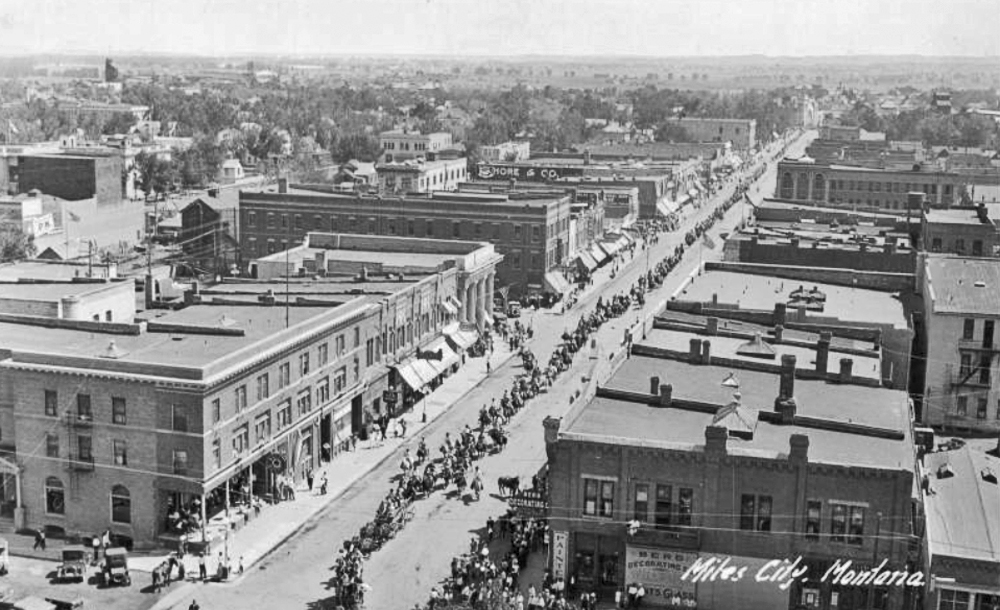
Miles City, ca 1935. Vintage Postcard.
Josephine eventually had to give up all the children, and at least four boys ended up in Miles City at the Montana State Industrial School (MSIS). The MSIS had been founded in 1893 as a “Reform School” for wayward boys and girls. Later it changed to the Industrial School terminology to emphasize its mantra of rehabilitation and skills training. (After 1920, girls were sent to their own facility in Helena.) In April 1914, state officials selected Arthur C. Dorr as the new superintendent. Dorr had nearly twenty years of relevant experience in Minnesota, including a stint running the state Reformatory. Dorr dramatically expanded the size and variety of facilities at the Montana institution.

Henry [Zorn] Miller first appeared at the school in December 1920, when he was eleven years old. There was a burglary charge involved, but his record gives “Incorrigibility” as his reason for being there. That strongly suggests that Josephine had thrown up her hands at trying to control him. Still, in keeping with the rehabilitation goal, the boys were kept on a fairly loose leash as they went about their daily assignments. Thus, in 1926, Henry “escaped” – most likely meaning he simply walked away.

His five-plus years at the Industrial School had given him a full “common school” education plus a range of vocational skills. But that provided little grounds for “white collar” work, while most manual jobs required a robust physique. At just over 5-feet, 1-inch in height, with a slender build, Henry was unlikely to impress potential employers. It seems inevitable (there’s that word) that he would turn to crime … specifically, burglary.

However, he was apparently not especially skilled at that endeavor. He was caught in Minnesota, under the name Henry Doyle, and convicted for a half dozen burglaries. With a cumulative twenty year sentence, Henry was registered at the Minnesota State Reformatory on October 10, 1926. There, he was identified as Miller. Then Arthur Dorr’s Minnesota connections gave Henry a break. Dorr was convinced that Miller could be rehabilitated. He got Henry released back to Montana in the summer of 1929 and found him a ranch job.

Henry [Zorn] Miller.
Montana State Prison.

Henry paid him back by burglarizing his safe at the school.  Soon caught, he was sentenced to five years at the Montana State Prison, being admitted as Henry Miller on October 26, 1929. After two or three years, he was released and deported back to Canada. But he returned and was spotted in Miles City. That violated Federal law, and this time he was sentenced to Federal prison. By now, his proper name had been discovered and Henry John Zorn was registered at McNeil Island, the Federal prison near Tacoma, on April 16, 1933. Again deported upon his release, he was caught illegally crossing the border in late June of 1934. However, he quickly escaped detention and vanished.

Had Alice (Dorr) Jones been a heavy sleeper, tragedy might have been avoided. Daughter of Superintendent Dorr, she had married Lester Thomas Jones in March of 1927. Lester was born November 21, 1905 in Miles City. After graduating from Custer County High School there, he received a scholarship to continue his education at the University of Montana. Besides his classes, he played on the school’s football team (he had played football in high school). He was also accepted into the Phi Sigma Kappa fraternity.

Lester joined the Industrial School faculty in late 1926 or early 1927. After he and Alice married, they moved into a two-room unit in the school’s Administration Building, across the hall from offices for Lester and the Superintendent.

August 12th was a typically hot summer day in eastern Montana, and Alice had trouble getting to sleep. The intruder couldn’t avoid some noise as he crept into the Administration Building not long after midnight. At first, Alice may have thought she was hearing ordinary creaks and groans. But then the burglar had to force the door of the superintendent’s office.

Alice prodded Lester awake, and he quickly donned a robe and went across to confront the prowler. She could make out only scraps of dialog … and then heard three quick gunshots. Seconds later, the shooter slammed out of the office, dashed to the main entrance, and bolted out. All she could register was that the intruder was short, dark, and slender. Hit twice, once directly in the heart, Lester Jones didn’t live long enough to have any last words.

The school’s Parole Officer supplemented Alice’s scant description of the killer. Alerted by the gunfire, he caught a glimpse from a second floor window. The fugitive’s footsteps were relatively light and very rapid; he had to be small and have a short stride. The killer left many clues inside: slugs from his weapon, a flashlight, an easily-remembered cap (“a gaudy checkered thing”), shards of light brown glass, a railroad spike, and marks on the door jamb. Outside, a searcher found another railroad spike alongside a pair of goggles with one lens broken out. The goggles – perhaps worn as a rudimentary disguise – were the source of the brown shards.

Superintendent Dorr immediately speculated that the burglar was a former School inmate; he seemed to know the layout well. Suspicion soon fell on Henry Miller. He had, after all, robbed the same safe before. And he fit the killer’s description, although Alice – who remembered him well from earlier – thought the intruder was darker. The resulting dragnet focused on the rail lines since the escapee had not run to an automobile. Many potential suspects were rounded up, but were soon released.

Henry became a more promising suspect when a “good enough” match to his fingerprint was found on the inside of the flashlight lens. That didn’t prove it had been he who left the light behind, but he would surely have some explaining to do. But where was he? Most people in and around Miles City only remembered him going off to McNeil Island in the spring of 1933. (The June 1934 detention and escape at the border apparently came out later.)

Then a tipster told police that Henry had been seen recently near a residential hotel in Billings, Montana. Diligent police work soon dredged up an ex-convict who had befriended Henry in prison. After some foot-dragging, he admitted that Henry had visited him on August 10th. He also stated that he had three messages from Henry, sent from eastern North Dakota. He had used the aliases “Henry J. Bertrand” and “Henry J. Brown.” Henry had left a suitcase in the ex-con’s room, and asked him to send it to Minneapolis, addressed to “Brown.” Montana officials hurriedly informed authorities there. Thus, on August 18, the fugitive was grabbed when he asked at the express office for any package in “his” name. He still carried what turned out to be the murder weapon.

It’s not entirely clear when Montana authorities brought private criminologist Luke S. May into the case. They may have consulted with him even before the arrest. They certainly did after Zorn’s attorney entered a “Not Guilty” plea. (Of course, officials now had his proper name.) In fact, the prosecutor personally carried several key pieces of evidence to Seattle, including Zorn’s revolver.

H&R .22-caliber Revolver.
Gun Sales Site.
The death weapon was an H&R (Harrington and Richardson) .22-caliber “Young America” model. May easily matched slugs retrieved from Jones’ body with test bullets fired from the gun Zorn had when he was arrested. Zorn liked fake names, but made no attempt to disguise his handwriting. Thus, May also proved, “beyond a reasonable doubt” that Zorn, Miller, Bertrand, and Brown were the same person. He also found hairs inside the cap that were “consistent with” strands from Zorn’s head.

The ex-convict from Billings was one of the first witnesses called when the trial began on October 2, 1934. Henry had told him on August 10 that he planned to rob the safe at the Industrial School. It would be “a cinch” since he knew the layout thoroughly. Still, just in case, he might go armed this time. The ex-con said he shrugged off the burglary plan, but adamantly refused to help him get a gun. Later that day, the ex-con observed that Henry had found himself a weapon. He didn't see him again until the young man was arrested.

We never do learn how Henry obtained the revolver. Several witnesses followed, including the coroner and Luke May. The trajectory of the fatal bullet to the heart, along with powder grains on Jones’ robe, showed that the shot was aimed at close range.

The defense called just one witness: Josephine (Schwanke, Zorn, Miller) Adams. She had married yet again  in 1925, and lived in Butte with her latest husband and son. She testified about the terrible life that Henry John had lived. A father with secrets (Why did he change his name?), who dragged them illegally into this country, and then abandoned them when Henry was a mere child. Was it any wonder he grew up angry and frustrated? But she still loved him, and pleaded for a life sentence rather than the death penalty.

The jury took little time on a “Guilty” verdict, but finally gave up on a sentence when one holdout refused to vote for the death penalty. After eight hours of futile argument, they left that up to the judge. The judge spent two or three days reviewing everything about the case. In the end, he found no mitigating circumstances: Zorn had deliberately planned a crime against those who had tried to help him. He had then gone out of his way to procure a deadly weapon, and fired a shoot intended to kill. The judge concluded: “I feel that under my oath, I have a duty I cannot shirk.”

Henry’s mother collected several thousand signatures on a petition asking the governor to commute the death sentence. He examined the court documents and refused. Henry John Zorn was executed by hanging early on the morning of April 24, 1935. His mother had him buried in Butte. She married yet again in 1937 and lived out her life in Butte, passing away in 1956.
 
After Lester’s murder, Alice continued as a matron at the school until she remarried in October 1940. Her new husband served as teacher and principal in Laurel (about 15 miles southwest of Billings) for eight or nine years. After 1951, he became an agent and then manager in Montana for an insurance company. At times, Alice taught kindergarten classes. Along the way, they raised a daughter and a son. They retired to Arizona in 1971, and Alice died March 3, 1981 in Casa Grande. She was buried in the Custer County Cemetery near Lester Thomas Jones (same Section, Lot, and Block).
                                                                               

References: Encyclopædia Britannica, Encyclopædia Britannica Ultimate Reference Suite, Encyclopædia Britannica, Chicago, Illinois (2012).
Luke S. May, “Dark Killer – Montana’s Midnight Marauder,” True Detective Mysteries Magazine, New York, New York (February 1936).
Luke S. May, Luke S. May Papers, Special Collections, University of Washington, Seattle, Washington (1969).
Tom Stout (ed.), Montana: Its Story and Biography, The American Historical Society, Chicago and New York (1921).
“[Zorn – Jones News],” The Missoulian, Missoula, Independent Record, Helena, Montana Standard, Butte,  Billings Gazette, Great Fall Tribune, Montana; Seattle Times, Washington (April 1914 – March 1981). 


Sunday, July 10, 2022

“Eternal Triangle” Claims Another Victim

Jealousy and envy have always been powerful motivators in human relationships. But what pushes one person to react with violence, when another might just walk away? We can never really know. The spring of 1930 brought such an event to central Washington.

The victim was Walter Cornelius Hornby, and he took a round-about path to reach the fatal venue. He was born around 1904 near a tiny North Dakota town midway between Fargo and Bismarck. His father, Benjamin, had emigrated to this country from England around 1887 and married Idella Fuller in July of 1890. He became a successful sheep rancher before renting out the property in 1905 and taking a job as postal clerk in nearby Jamestown. Walter was one of eight siblings – all boys – who survived past infancy.

Jamestown, ND. Vintage Postcard.

 In 1916, all but two of the family moved to Canada. They settled on a stock ranch about fifty miles southeast of Edmonton, Alberta. (The other two brothers also moved to Canada within a year so.) Naturally, Walter worked on the family ranch. He continued to work for his father when they moved to a new place about twenty miles west of Edmonton. Here, Ben diversified the operation to include growing potatoes and grain. He also sought more land for stock raising.

During this period, brother John Hornby joined the Canadian army. After transferring to the U.S. forces, he spent a year in France. Badly injured in an accident, he ended up with a silver plate in his skull and spent seventeen months in various hospitals. He may have received a disability pension after his discharge in late 1919, but available records are unclear on that point.

Despite their father’s success, six of the brothers returned to the United States over the period from 1920 to 1923. Walter and two younger brothers followed John to Spokane. (Hornby relatives lived in northern Idaho and in Spokane at the time.) Walter apparently made a living with part time farm work and odd jobs in and around Spokane. He was thus there when the youngest brother Frank, age 16, suffered an attack of “acute pneumonia.” Frank died within about 24 hours, in January 1928. Burial was somewhat delayed while Ben and Idella made their way from Canada.

Some time after his brother’s sudden death, Walter found a job in Cashmere, a small town located 10-12 miles northwest of Wenatchee. The Cashmere area was, and is, renowned for its orchards, mainly apples, but also pears, apricots, and more. Besides the fruit itself, a company in the town shipped packages of fruit-based confections all over the country. In Cashmere, Walter – “Red” to his friends – met Delbert Brown, a fellow farm and ranch hand. They became best buddies, working and playing together. They probably shared a work hut at times, and may have gone on camping trips together.

Adelbert J. Brown was born September 27, 1902 in Anacortes, a harbor town in northwest Washington, about thirty miles from the Canadian border. In 1910, he had three siblings: two brothers and a sister. His parents separated some time after that, with the mother retaining custody of the children. Then, in the summer of 1917, his mother married a blacksmith who lived in Cashmere.

Delbert had suffered from epileptic fits since childhood, but his symptoms were apparently mild. Thus, in June 1918, he and his mother fudged enough about his age so he could join the U.S. Army. He was assigned to the Coastal Artillery Corps and served in San Juan, Puerto Rico, and the Panama Canal Zone. He was mustered out in the spring of 1923.

By that time, his father had also moved to the Cashmere area. Oddly enough, Delbert’s father got on well with his stepfather: They had been jailed and/or fined together for repeated violations of Prohibition. In fact, officials later asserted that the family had “caused more trouble around Cashmere for the last half dozen years than the rest of the town combined.” One brother was fined and jailed for assault in 1925. The other also had run-ins with the law, although the details are unknown.

Still, Delbert seems to have kept a low profile. He and his buddy Red Hornby worked hard and stayed out of trouble. That happy situation began to change in early 1930, after Mrs. Lela (Stitch) Morris delivered her baby girl, Flora.

Lela Valentine Stitch was born February 13, 1913 in Post Falls, Idaho. In November, 1926, the family was living in Porthill, Idaho, a hamlet on the Canadian border about 22 miles north of Bonners Ferry. There, Lela’s mother had a heart attack and died at the young age of 33. Two years later, Lela married John Francis Morris. She was a couple months past her fifteenth birthday, he was 20 years old. Originally from Minnesota, Morris was then working at a car dealership in Kellogg, Idaho.

Not long after, John and Lela took up residence in Creston, British Columbia, about seven miles north of Porthill. Then, in late August, 1929, Lela crossed back into the States. Just sixteen years old, she came alone … and pregnant. Her destination was Cashmere, where her mother’s sister, Hattie (Stitch) Romanoff, lived.

Lela was not yet seventeen when she gave birth to Flora on December 28. Aunt Hattie already had three children of her own, so arrangements were made to secure a place for the new mother and her infant. Lela also began the process to divorce her husband. Her grounds for the request are unknown.

As it happened, Aunt Hattie knew both Delbert and Red. (Cashmere had a population of less than 1,500 at the time.) They might have simply met Lela at the Romanoff home, or Hattie may have made a point of introducing them.

In any case, newspapers would report that both began “courting” her when she opened the divorce proceedings. Delbert certainly had hopes. Hornby, however, seems to have had no such plans. Afterwards, Lela said there was nothing romantic between her and Red; he was just a helpful friend. She also claimed that Delbert knew that to be the case.

Then, on Saturday March 29, 1930, Lela told Delbert that she didn’t want him coming around any more. She never explained why. Perhaps she was tired of being romantically pursued by a man more that ten years her senior. Or possibly she had new hope of reconciling with her husband. Distraught, Delbert went off and bought a .38-caliber revolver. He then visited Hattie and told her he planned to kill himself with it because Lela had “thrown him down.”

She persuaded him to go home and get some sleep, and he promised to do so. But a half hour later, she got a frantic call to her niece’s place. There she found Lela hysterical, with the body of Red Hornby on the floor. Hornby had been helping her with some spring cleaning. Despite her rejection, Delbert had stopped by once again. When he saw Hornby there, he instantly opened fire, hitting his former friend four times in the back. He also threatened Lela, but she managed to escape.

Minutes later, officers rushed to Delbert’s home, where they found him lying on the bed with a self-inflicted wound to the chest. He was transported to a hospital in Wenatchee, not expected to live. Even so, he almost immediately tried to commit suicide by jumping out a hospital window. Restrained from that, he asked to see his father and mother … and Lela. She went and stayed for some time, feeling she was somehow to blame for the awful events.

Three weeks later, Delbert was well enough to sit up, and the feeling was that he would live after all. Prosecutors therefore filed a first-degree murder charge against him. He had already admitted to killing Walter and even wished that “he could do it again.” Still, a capital offense had to be tried in court, and that brought Luke May into the case to verify the death weapon.

Meanwhile, John Hornby had the sad task of retrieving his brother’s body. They again had to delay the service while the parents traveled from Canada. Eventually, four of the Hornby brothers, as well as Ben and Idella, would be interred in a cemetery on a beautiful stretch of the Spokane River just west of the city.

Brown’s trial was set for October. While Lela waited to testify, she re-united with her husband in Wenatchee. Tragically, on August 14, little Flora died suddenly from “acute intestinal intoxication,” then a poorly-understood malady that killed almost half of the infants who suffered it.

Under the circumstances, Delbert’s only viable plea was “not guilty by reason of insanity.” The defense had some basis for this, although it’s not clear how much was presented to the jury. At the time of the trial, Delbert’s youngest brother was confined at the state psychiatric hospital in Spokane County. His other brother was in the state reformatory. He had shown signs of instability for quite some time, and would be moved to the same psychiatric unit within a few years. And the stigma of Delbert’s epilepsy strengthened the notion that he might be unbalanced.

In the end, the trial boiled down to “dueling experts,” several for the defense versus two with impressive credentials for the prosecution. The jury found him guilty but did not recommend a death penalty. Delbert was sentenced to a life term in prison, but he cannot be found in penitentiary records for either the 1940 or 1950 censuses. Thus, it seems likely he was confined for many years in a psychiatric facility, perhaps for most of his life. The next mention of him in available records was his death in Cashmere on December 12, 1971.

John and Lela Morris clearly had to grow up in a hurry with the death of infant Flora. Still, shared grief surely strengthened the bond between them. They returned to Porthill some time after the trial. There, Lela bore a son in early 1932. Two daughters followed in 1933 and 1935. They spent three years after 1936 in Canada, where another daughter was born. They then returned to Porthill, where they became the core of a thriving family, including another daughter born in 1945.
John and Lela Morris. Family Archives.


At least three of their children graduated from the University of Idaho, and two of the girls met their husbands there. After serving with the U.S. Army in Korea, the son spent his life in North Idaho, mainly on property he owned near Porthill. As could be expected, the daughters scattered with their respective husbands: Modesto, California; and three in Washington – Bellevue, Bellingham, and near Vancouver. All the children raised families of their own.

A snapshot from John and Lela’s fiftieth wedding anniversary (1978) shows at least three and perhaps four generations. Lela (Stitch) Morris passed away April 19, 1981. John Morris moved into a nursing home in Bonners Ferry around 1990. He died there in late 1993, survived by all but their youngest daughter. He was described as having 17 grandchildren and 32 great-grandchildren.
                                                                                

References: Laura Arksey, “Cashmere — Thumbnail History,” Online Encyclopedia of Washington State History, HistoryLink.org, Seattle, Washington (August 30, 2008).).
Encyclopædia Britannica, Encyclopædia Britannica Ultimate Reference Suite, Encyclopædia Britannica, Chicago, Illinois (2012).
David R. Nalin, “The History of Intravenous and Oral Rehydration and Maintenance Therapy …,” Tropical Medicine and Infectious Disease, 7, (3): 50, Multidisciplinary Digital Publishing Institute [MDPI], Basel, Switzerland (March 12, 2022).
Luke S. May, Luke S. May Papers, Special Collections, University of Washington, Seattle, Washington (1969).
“[Murder and Trial]," Bellingham Herald, Tacoma Ledger, Spokane Chronicle, Spokesman-Review, Spokane, Washington; The Oregonian, Portland, Oregon (March 1930 – October 1930).
“[Family Histories],” Jamestown Alert, North Dakota; Bonners Ferry Herald, Idaho; Bellingham Herald, Spokane Chronicle, Spokesman-Review, Spokane, Washington; Edmonton Journal, Alberta, Canada; (July 1888 – December 1993).

Thursday, May 19, 2022

Death In Little Italy

Tacoma, Washington, early 1929: Vincenzo “James” Cappa brutally murdered Francesco “Frank” Cusato. The details of Why? were never fully explained. But the aftermath included the later death of Cappa himself. Cappa was born January 14, 1866 in Calabria, an area that forms the “toe” of the Italian boot. Cusato was born nine months later, on October 29, 1866, also in that region. Little is known about their early lives, except that Cusato’s father died in 1879 or early 1880, and his mother soon remarried.

How the two came to be in Tacoma tells a fascinating story of how the broad sweep of history plays out in the lives of individuals. The occupation of Rome by the Italian army in September 1870 completed the unification of the peninsula and solidified the creation of the Kingdom of Italy. The unifiers, almost all from the north, then settled down to try to govern their new country. Integration was severely hampered by the lack of a true national language. At the time, few people (less that 3%, according to one scholar) could properly use “Standard Italian” – a “prestige” variant adapted from a Tuscan dialect.

In fact, different parts of Italy had, and still have, their own vernaculars that linguists consider “sister languages,” not dialects of any common form. Some variants were different enough that speakers might switch to Standard Italian to avoid misunderstandings. Ordinary conversation, especially among the poor and least educated, continued in their “native tongue.”

For reasons that are beyond the scope of this blog, the new government’s policies imposed disproportionate hardships in the already-impoverished south. (Even now, specialists in Italian history argue about the root causes.) But the resulting mass exodus is clear in the numbers: Records show that as many as 300,000 Italian immigrants came to this country during the decade after 1880. Seventeen-year-old Vincenzo Cappa was among them, arriving at New York City in the spring of 1883. Here, he most often went by “James,” which was probably his Roman Catholic confirmation name.

James was illiterate, with only a limited command of English. Still, a hard-working manual laborer could find jobs if he was willing to go anywhere and do anything. A decade later, we find him in Tacoma, probably as a railroad section hand. He gravitated to the local “Little Italy,” in the Hilltop neighborhood west of downtown where many immigrants from Calabria had settled. While small in comparison to most such districts – an estimated 400-600 members in 1893 – the community offered ties to a familiar language and culture. Before the decade was out, James married fellow Italian immigrant Rosina “Rose” Vercillo at Saint Leo Catholic church in Tacoma.  
St. Leo Catholic Church. Vintage Postcard.


Meanwhile, the exodus from their homeland continued … almost 600,000 coming to the U.S. in the decade after 1890. Francesco Cusato somehow endured those years. He had also acquired a half-brother, Michele “Mike” Sita, a few years after his mother remarried. Mike would play a key role in Frank’s future.

Matters in Italy came to a head near the end of the decade. A major failure in the wheat crop caused a spike in prices, followed by widespread “bread riots.” A savage over-reaction by the military resulted in many civilian deaths, and only fueled further strife. Frank’s stepfather moved to this country a few months before Italy’s king was assassinated in the summer of 1900. He too ended up in Tacoma’s Little Italy.

The murder of the king did spark changes, some good, some bad. On the plus side, officials created a Commission on Emigration to guide those who wanted to leave. Frank’s brother Nicola “Nick” Cusato and half-brother Mike also immigrated and settled in Tacoma. Frank finally joined them there in June 1906. He was forty years old, could not read or write, and had poor English. Like Cappa, he found manual labor jobs wherever he could: on the docks, in construction, mining, and more. He never married, but Nick and Mike did, and Frank would eventually have eight nieces and nephews.

James and Rose Cappa had six children by 1910: two daughters and four sons. Being still unable to read or write, James had to make do with odd jobs to support the family. Luckily, Rose could read, which helped open a few more doors. James finally found better-paying work at a lumber mill … still physically demanding, but it offered some hope of advancement.

As Frank Cusato grew older, he escaped the treadmill of hard physical labor through a family connection. Half-brother Mike Sita had started the same way Frank did, but then found a different route. Around 1911, he went to work at a shoeshine parlor. His flare for the job, and winning personality, made him an immediate success. In fact, Mike proved to have a knack for the business, with his own shop by around 1915. Within a couple years, he opened a larger shoeshine parlor at a better location.

That made room for Frank, who worked as a bootblack in Mike’s shop until at least 1923. (That same year, Frank’s stepfather, Mike’s father, was killed in a railroad yard accident.) Available records for Frank are rather spotty after that. However, there are indications that he worked at least part time at the parlor for several more years.

We also don’t know how long James Cappa stayed with the sawmill job. However, at some point he acquired a small partly-developed property about a half mile west of the family home. He kept a few cows on the land and sold the milk. Although one son had died – in 1918, probably from the so-called “Spanish” flu – his family had grown to nine living children (six daughters and three sons) by 1925.

Over the years, James Cappa and Frank Cusato had become friends. They obviously had a lot in common: near the same age, Roman Catholic, and from the same region of Italy. And both had spent most of their lives doing hard physical labor. After about 1928, when they had semi-retired, Frank lived in a shack less than two hundred yards from James Cappa’s little dairy. Most evenings, they got together at Cappa’s place to play cards.

As noted above, no one knows exactly what happened on Saturday morning, January 19, 1929. The weather was miserable, with temperatures below freezing, strong northerly winds, and occasional snow flurries. Cusato showed up about 7:30 a.m., while Cappa was washing milk bottles. James claimed that Frank immediately began saying “bad words” about “a woman of the neighborhood.” It appears – although never proven for sure – that the two had a long-standing difference of opinion about this woman. She was never identified, which suggests that there was some family connection. The community might have known, but would not have revealed that fact to outsiders.

Nor do we know the nature of the “bad words.” Newspapers used the word “taunt” in their articles. However, we don’t really know if that captured the proper nuances of the exchange in Calabrian vernacular. Given the violence of Cappa’s reaction, one may infer that the woman was related somehow, and that the purported transgression was of a sexual nature. But that’s only speculation.

Cappa demanded that Cusato leave and, when he didn’t, smacked him with a milk bottle. Cusato still wouldn’t go and the two struggled a bit. Now thoroughly enraged, Cappa broke free and rushed into his bedroom where he kept a revolver. In some versions, Cappa claimed that Cusato had picked up a club, or perhaps a hatchet, by the time he returned. In any case, Cappa shot two or three times and Cusato fell. Still in a blind rage, Cappa said, he picked up a rifle (where that came from was never explained either), and bashed his victim several times. The blows fractured Cusato’s skull before the weapon broke.

One report said he reloaded the revolver and dropped it in a pocket. In any case, he then went to a neighbor and had them call police. Officers found Cappa inside, “covered with blood” but not injured. Cusato’s body was on the porch, not in the kitchen. Cappa must have moved it, although he never mentioned doing so. In fact, Cappa probably never offered any one clear account of what happened. Police even enlisted a prominent member of the Italian community who had previously spent ten years as a city detective. He helped piece together a somewhat plausible sequence from multiple versions.

As it happened, Tacoma Captain of Detectives John Strickland was familiar with the scientific detection skills of private criminologist Luke S. May. Thus, Tacoma authorities quickly hired him to help with the case. May’s verification of the death weapon would have been a routine matter by 1929. However, he also logged the case as involving “bloodstains,” surely meaning blood spatter analysis. The pattern of stains would have told its own story. 
Tacoma, ca 1929. Tacoma Public Library.


However, we don’t know what May’s report said because the case never went to trial. Cappa was initially charged with second degree murder, to which he (his lawyer) pleaded “not guilty.” Family and friends raised his $10,000 bail, so he did not spend a long time in jail awaiting arraignment and trial. Even so, the strain soon ruined his health. Rather than go to trial in mid-March, James pleaded guilty to the lesser charge of manslaughter. Rose and his attorney had to steady him so he could stand for the reading of the sentence: one to ten years in the state penitentiary.

James remained an invalid for the rest of his life, and does not appear to have spent any time in prison. He was at home with his family for the census in the spring of 1930. It’s a tribute to his basic toughness that he lasted until December of 1932.

James left a large family. Oddly enough (given the norm for that era), of the nine children who survived to adulthood, five never married. That included two of the three sons, and the one son didn’t marry until long after his mother died. Still, the children did well by “the American Dream.” The three sons all went into far better paying fields than their father could have ever hoped for: One owned a custom upholstery business and another was a pharmacist.

The three daughters who married had husbands with skill-based positions: professional gardener, bottler, and studio photographer. Daughter Eva trained in photography and assisted in her husband’s studio. Of the three unmarried daughters, one became a social worker for the state of Washington, another had a long career at Sears, and the third was a nurse.

The three married daughters, despite their Roman Catholic heritage, did not raise large families. One, in fact, had no children. Thus, when Rose (Vercillo) Cappa died April 9, 1952, she’d had time to enjoy just three grandchildren … all males.
                                                                                
References: “[Cappa-Cusato News],” News Tribune, Tacoma, Seattle Times, Tacoma Ledger, Washington (January 1929 – December 1932).
Encyclopædia Britannica, Encyclopædia Britannica Ultimate Reference Suite, Encyclopædia Britannica, Chicago, Illinois (2012).
Rita Cipalla, “Little Italy Communities Helped Early Immigrants Adjust To New Lives,” L’Italo-Americano newspaper, New York, New York (November 1, 2020).
Luke S. May, Luke S. May Papers, Special Collections, University of Washington, Seattle, Washington (1969).
David Wilma, Walt Crowley, “Tacoma – Thumbnail History,” Online Encyclopedia of Washington State History, HistoryLink.org, Seattle, Washington (January 17, 2003).

Monday, April 4, 2022

Death On A Snowy Night

Heavy snow began piling up in the Cascade Mountains of Washington shortly after New Years Day of 1933. The winter was promising to be one of the snowiest on record. On the weekend of January 21, a storm added ten inches more at Snoqualmie Pass. All that was good news for Cle Elum, a small town located about thirty miles southeast of the pass. They had “one of the first organized ski areas west of Colorado,” which drew thousands of seasonal visitors. 
Early Cle Elum. Central Washington University

A strong season would also be good news for Abram Perry and his “second hand” store – something like a pawn shop, but generally without the loan service. At the time, ski shops as we know them were confined almost entirely to New England and eastern Canada. Customers would surely find their way to his place on First Street to try out this new thing, or to upgrade their skis, sleds, and toboggans.

Born around 1866 in New Brunswick, Canada, Abraham G. Perry moved to this country around 1885 and became a naturalized citizen three years later. Soon after, he took a job as a coal miner near Cle Elum. A first marriage in late 1890 lasted less than a year because Abram, as he began to call himself, proved to be an abusive husband. He married again in 1896, to Alena “Lena” LeCole. By then, coal had been discovered right in Cle Elum, and the town boomed. It incorporated in February 1902, and Abram opened his first store some time the following year.

Perry prospered along with the town, even more so after 1915, when Cle Elum became a popular stop on the new main highway across central Washington. However, some time during that period, the Perrys chose to separate (they had no children). Abram retained the store, while Lena owned a farm property near Cle Elum. There’s no record that they ever divorced, although Abram gave that status for the 1920 census. Lena simply told the census taker that they “lived apart.”

As time passed, locals came to believe that Perry was “one of the wealthiest men in Upper Kittitas County.” He did not, however, trust banks – which tended to “go bust” with alarming frequency during that era. (That really began to look like a smart move, as the Great Depression ruined even more financial institutions.) Still, rightly or wrongly, it became “common knowledge” that Perry had caches of money hidden all around the store and his attached living quarters. The consequences were tragic.

On the afternoon of January 25, 1933, the Cle Elum mail carrier found the door to Perry’s store locked. Peering inside, he saw the storekeeper sprawled on the floor, not moving. Concerned, he forced the door and found that Abram was dead from a gunshot in his back. A flashlight lay near the body, but no weapon. Abram was known to keep at least one revolver under his pillow, so the killer had most likely taken it away with him. News reports never said how he got into the store.

Also, there’s no way of knowing why the intruder gunned down the old man, rather than simply disarming him. Perhaps he feared that Perry would recognize him. He supposedly got away with $2,000 in cash. He did not take time to pry open the “old fashioned” combination-lock cash drawer, which contained another $800. A coat of fresh snow with drifting due to strong winds during the night covered any traces of how the killer had come and gone.

The coroner retrieved a .30-caliber slug from Perry’s back, and estimated that he had been killed on the evening of the 24th. Officials must have immediately consulted with private criminologist Luke S. May. News reports the day after the body was found identified the death weapon as a German Luger automatic pistol … in the lighter .30-caliber (technically, 7.65 mm) model.

With that information, police in Ellensburg arrested two armed suspects that same day. A deputy then delivered their weapons – one a 7.65 mm Luger – to May in Seattle. May could ignore one gun, since it was the wrong make and model. The Luger automatic was not, however, the death weapon. With so little to go on, the investigation soon stalled and then basically went cold.

Not just anyone can run a “second hand store” successfully. (It takes a particular mix of personality, knowledge, and bargaining skills.) Thus, we don’t know what happened to Abram’s business after he was murdered. Most likely, Lena operated it for some time while she sought a buyer. Meanwhile, a year passed with no results on finding her husband’s killer. We don’t know exactly when she wrote a letter to the governor pleading for action. But as a result, in May 1934, the governor had the State Patrol assign two detectives to the case. Of course, they had no more to go on than the original investigators, and made no progress either.

However, we may infer that they kept the case active with periodic bulletins and requests for information. That finally paid off in December. A rancher who raised fruit in an area just north of Yakima provided the breakthrough. News reports are vague on some key points about why he came forward. However, circumstances suggest that he spoke up after Yakima police arrested one Lee Harrison on an unrelated burglary charge.

Edgar Lee Harrison was born February 7, 1894 in a rural area about fifty miles east of Springfield, Missouri. In late 1917, he moved to the Yakima Valley in Washington. He married a Yakima waitress in January 1920, and soon began using “Lee” instead of Edgar for most business and personal matters. The marriage lasted only until about 1924. They had no children. During that period, Lee learned how to operate a steam locomotive.

He remarried in November 1928, to Minnie E. Cargo. However, he was laid off from the railroad in 1931 and had to make do with odd jobs. Also, police apparently began to view Harrison as a possible suspect in a number of local burglaries. They might even have picked him up for questioning on some cases. In any event, solid evidence was lacking until he was actually arrested in December 1934.

Harrison had worked for the fruit rancher during the summer of 1933. The rancher overheard him talking about the Perry murder and asked him about it. Harrison claimed that he and an accomplice had pulled off the job. He later gave at least a dozen slightly different versions of the story. Thus, the rancher apparently decided it was all just a big brag to make himself look like a “tough cookie,” and never reported it. But now, Harrison was revealed to be a bone fide burglary suspect. Perhaps there was something to the talk after all.

Confronted about the Perry story, Harrison admitted that he had burglarized the store and shot the old man. Besides identifying the murder weapon as a German Luger, he also provided details that could have been known only to the perpetrator. But he also claimed that he wasn’t entirely to blame. The intrusion had been provoked by a man named Jack Slagle, of Bellingham. In the fall of 1932, he had started talking up all the money Perry supposedly had hidden around his place. He had finally badgered Harrison into joining the venture. The police should go after him too.

John B. “Jack” Slagle was born September 27, 1887 at a place 80-90 miles east of Wichita, Kansas. He moved to Washington before 1910, settling a few miles from the Canadian border, midway across the state. He married there in November 1913. The bride’s maiden name was Vera Sophia Ethel, but after two or three years she began using the name “Veva.” The couple had three children by 1920 – two sons and a daughter. Starting about that time, Jack’s name began to appear in the news for violations of gambling and liquor laws. He perhaps wore out his welcome in that area, because the family moved to Bellingham in 1926.

There, Jack could not seem to find steady work, and spent time in jail in 1928 on liquor law violations. He was back in trouble for illegal gambling in the spring of 1931. The strain on his marriage became too great by 1932. After that, Veva and the three kids lived together and Jack was on his own. She filed for divorce a couple months after he was arrested on a burglary charge in Yakima in May 1933. Police had caught Jack and three “companions” with safe-cracking tools, dynamite, and some weapons. However, nothing linked them to any specific crime, so prosecutors had to release them.

Coincidentally, Slagle was already a suspect in a Yakima safe-cracking case when Harrison named him in his confession. However, Jack had left Bellingham four days before Yakima authorities issued a warrant for his arrest. Unaware of the warrant, he showed up in Yakima and was locked up immediately. He vehemently denied any involvement in the Perry burglary-murder. Even so, authorities transferred him to the Kittitas County jail in Ellensburg (the county seat) on January 5, 1935. However, except for the Harrison statement, officials had no actual evidence against Slagle. They released him a few days before Harrison’s trial, which began April 8, 1935. 

Kittitas County Courthouse.
Central Washington University.
On the stand, Harrison claimed that he played no part in the Perry murder. His stories about it were based on what Slagle had told him. He further asserted that police had used extreme “force and duress” to get him to confess to something he hadn’t done. He and wife Minnie even offered an alibi. After buying some moonshine the day before, they had then partied all through the day that Abram Perry was murdered. Thus, neither was in any shape to go out that night. They had evidence for the booze purchase, but had no one who could verify the binge party.  The jury took a little over two hours to reach a “guilty” verdict. He received a life sentence.

At this point, Harrison’s detailed accusations against Slagle appeared in the public trial record and were all over the news. Thus, prosecutors felt they had to proceed against him. He was re-arrested and went on trial in June. Besides the Harrison statement, prosecutors had a witness who heard Slagle mention the old man’s money, and others who placed him in Cle Elum some time before the murder.

The jury did spend eight or nine hours considering the relevance and credibility of the testimony, but finally issued a “not guilty” verdict. After the trial, Slagle settled in Yakima and married a widow in November 1939. She passed away a little over two years later. Jack lived in Yakima until at least 1950, but died in rural King County in the spring of 1953.

We don’t know how long Lee Harrison spent in prison, but he was still there when Minnie divorced him in September 1943. However, by 1951, he was living in Oregon. At some point, he married again … to “Mabel.” He passed away in southern Oregon in September 1964.

Lena (LeCole) Perry married again in January 1939, to a farmer with a place just south of Cle Elum. She died on December 31, 1943.
                                                                               

References: Jim Kershner, “Cle Elum – Thumbnail History,” Online Encyclopedia of Washington State History, HistoryLink.org, Seattle, Washington  (October 11, 2013).
John W. Lundin and Stephen J. Lundin, “Cle Elum Ski Club,” Online Encyclopedia of Washington State History, HistoryLink.org, Seattle, Washington  (August 27, 2012).
Luke S. May, Luke S. May Papers, Special Collections, University of Washington, Seattle, Washington (1969).
“[Perry Case News & Background],” Post-Intelligencer, Seattle; Spokesman-Review, Spokane; Daily Olympian, Olympia; Oroville Gazette, Bellingham Herald, Seattle Times, Washington (June 1891 – June 1935).